Vending Basics for New Operators
Where to buy vending products and how to price them.
What you pay for product and what you charge for it decide your margin. Here is where operators buy as they grow, how to buy for resale, and how to set a price.
Buy where it fits the size of your route.
A warehouse club works for the first few machines. A wholesaler or distributor makes sense once you buy for a whole route.
Warehouse clubs
Small quantities for your first machines, with a paid membership.
Cash-and-carry wholesalers
A growing route, with a business account and your resale certificate.
Vending distributors
A full route. Ask each one about minimum orders and delivery days.
Manufacturers, brokers and bottlers
Drinks and high-volume items. Ask your local bottler about its programs for operators.
Online business buying
Specialty and healthier items. Check shipping time, case sizes and dates.
Vistar, a vending distributor, runs 24 distribution centers for candy, snacks and drinks.
Buy for resale without paying sales tax.
Products you buy to resell can be bought without sales tax when you give the seller a resale certificate. Texas, for example, exempts a taxable item bought for resale when the seller accepts a completed certificate, and a sales tax permit number alone is not a substitute.
States tax vending sales their own way too. California taxes 33% of gross receipts from cold food sold in vending machines, and carbonated drinks in full. Dryline’s Tax Center applies the rate at each machine’s address and taxes each kind of product the way that state, county and city tax it.
Know your cost per unit.
Work it out on every purchase
The case price divided by the units in the case.
Buy what sells
Order from your sales by product, not from what is on promotion.
Check the dates
Buy short-dated items only when they will sell in time.
Keep backstock small
Backstock is the product you store between visits. Hold enough for your next few visits.
Price from your cost, then check the store down the street.
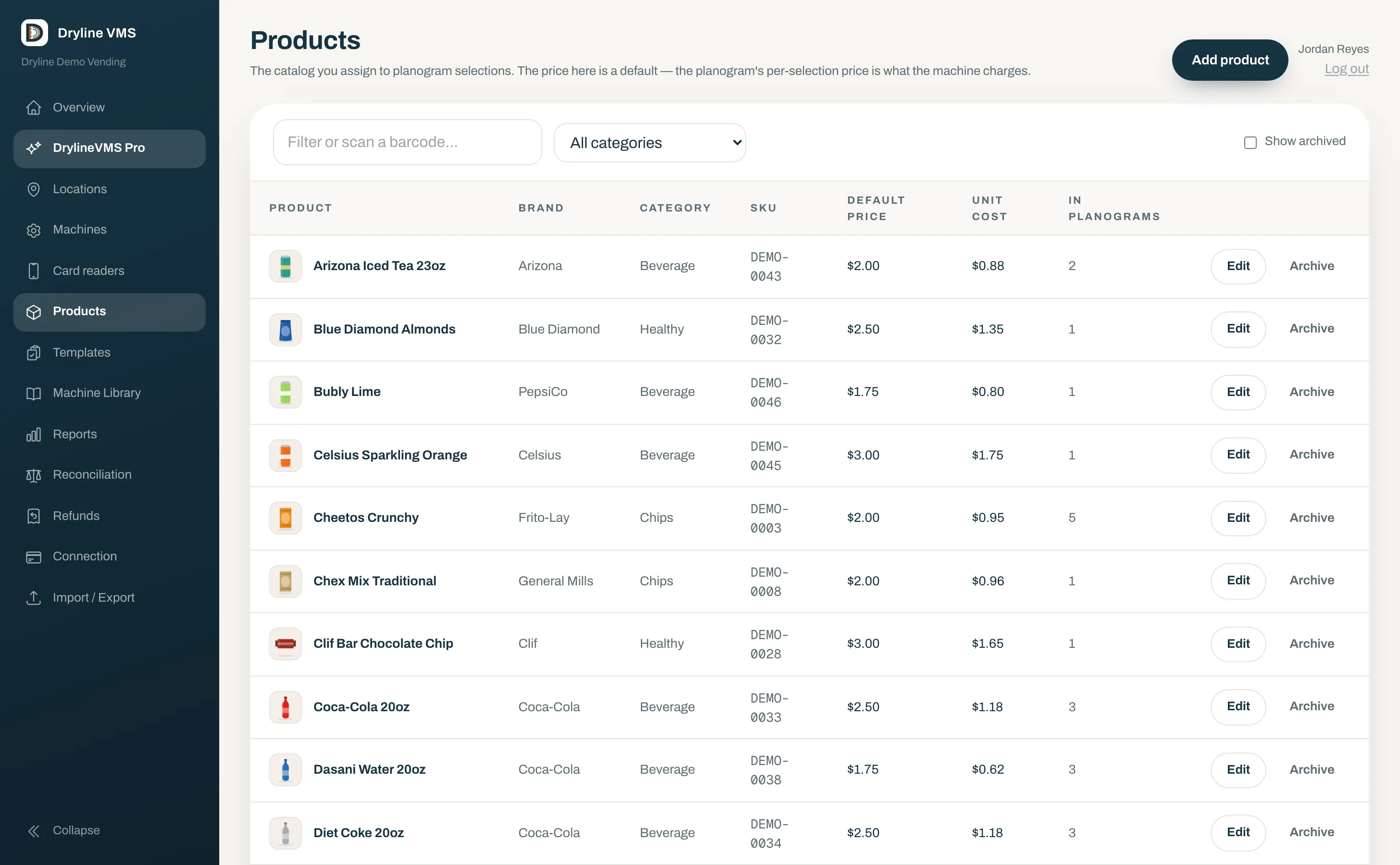
Margin is the share of the price you keep after the product’s cost: price minus unit cost, divided by price. A bag of chips that costs $0.95 and sells for $2.00 has a 52.5% margin. Vending prices include sales tax, so take the tax out first.
Set a target margin, check the nearest convenience store rather than the grocery store, and round to a simple price ladder so similar items share a price. Change one price at a time when costs rise, and watch units sold for a few weeks.
Price for card payments.
A card pays the exact price, so a price no longer has to suit the coins in a pocket. Visa allows a surcharge only on credit cards, capped at 3% or your processing cost, and several states ban surcharges, so one price for every customer is simpler. The cashless guide covers what else cards change.
How Dryline keeps cost and price together.
The price in the planogram
Each selection’s price lives in the planogram, and on a card sale the Rain Pay reader asks for exactly that amount.
Central warehouse
On DrylineVMS Pro, the warehouse tracks the stock you hold and builds each route’s load in one step, listing any shortage.
The Vending Operator Playbook has a pricing worksheet you can print.
See cost and price side by side.
Each product carries its unit cost beside its default price, which is what reports and commissions on gross profit use.
Questions about sourcing and pricing
- Do I need a membership to buy at a warehouse club?
- Yes. A Sam’s Club membership starts at $60 a year.
- How much have vending prices gone up?
- The government’s price index for food from vending machines and mobile vendors rose about 50% from December 2019 to September 2026, and 2.0% in the most recent year.
More vending basics.
Why offer cashless
What card and phone payments add for customers and for you, and what a machine needs to take them.
Tap to Start, Select First, and Multivend
Pay first, choose first, or buy several items with one tap, and why your machine has a say.
How MDB works
How the controller runs the coin mechanism, bill validator, and card reader on one connection.
Planograms
The map of a machine: what goes in each slot, at what price, and how full to fill it.
Stocking strategies
A first product mix, par levels, rotation, and restocking the machines that need it.
Starting a vending business
Licenses, sales tax, insurance, machines, locations, commissions, pricing, and routes.
Finding locations
Where to look, how to score a site, and how to pitch the manager who decides.
Agreements and commissions
What every location agreement covers, and the commission models compared with real math.
The Vending Operator Playbook
Every business guide in one printable workbook, with a site scorecard and a pricing worksheet (PDF).
See your margin on every selection.
Book a 20-minute demo and see product costs, planogram prices and reports on real screens.