Vending Basics for New Operators
How to find vending machine locations and win them.
The location decides what a machine can earn. Here is where to look, how to score a site, how to pitch it, and what to check before you pay anyone for one.
Look for places where people stay.
A location is the business that hosts your machine. The best first locations have a captive audience: people who spend hours there, at times when a store is closed or too far away to bother.
Offices and break rooms
The same people every workday, many with short breaks.
Factories and warehouses
Long shifts, nights and weekends.
Gyms
Drinks and protein after a workout.
Apartments, dorms and hotels
Residents and guests after nearby stores close.
Auto shops and laundromats
Customers stuck waiting.
Schools and public buildings
Steady traffic, often put out to bid, with nutrition rules to follow.
Score every site before you pitch it.
People
Enough people on site every day, staying long enough to get hungry or thirsty.
Hours
Long opening hours, and access to the machine around the clock if you can get it.
No easy alternative
No store, cafeteria or other machine a short walk away.
Space, power and signal
A dedicated outlet, a level floor, doorways the machine fits through, and cellular coverage or Wi-Fi for the card reader.
A decision maker
A manager who can say yes and sees the machine as a perk.
Give each point a score and pitch the highest-scoring sites first. The Vending Operator Playbook has a weighted scorecard you can print.
Win the location with a one-page proposal.
Ask for the person who decides: an office or facilities manager, a property manager, the owner of a small business, or HR when the machine is a staff perk. Leave a one-page proposal that says what you will stock, how often you visit, how people pay, how refunds work, and that the machine costs them nothing beyond the power outlet.
Then ask for a trial: put one machine in for 90 days and look at the numbers together. When a manager says they already have a vendor, ask what they would change. Empty coils, no card reader and slow refunds are common openings.
Check anyone who sells you locations.
Some companies sell machines bundled with locations, or charge to find locations for you. Under the FTC’s Business Opportunity Rule, the seller must give you a one-page disclosure document at least seven days before you sign or pay, and you can ask for written proof of any earnings claim. Americans reported losing $750.6 million to business and job opportunity scams in 2024. Visit each location and meet its manager before you pay anyone.
Put the deal in writing.
Every location gets a written agreement, with the commission, the service you promise and how either side ends it. The location agreements and commissions guide lists what to cover and compares commission models.
See which locations earn their spot.
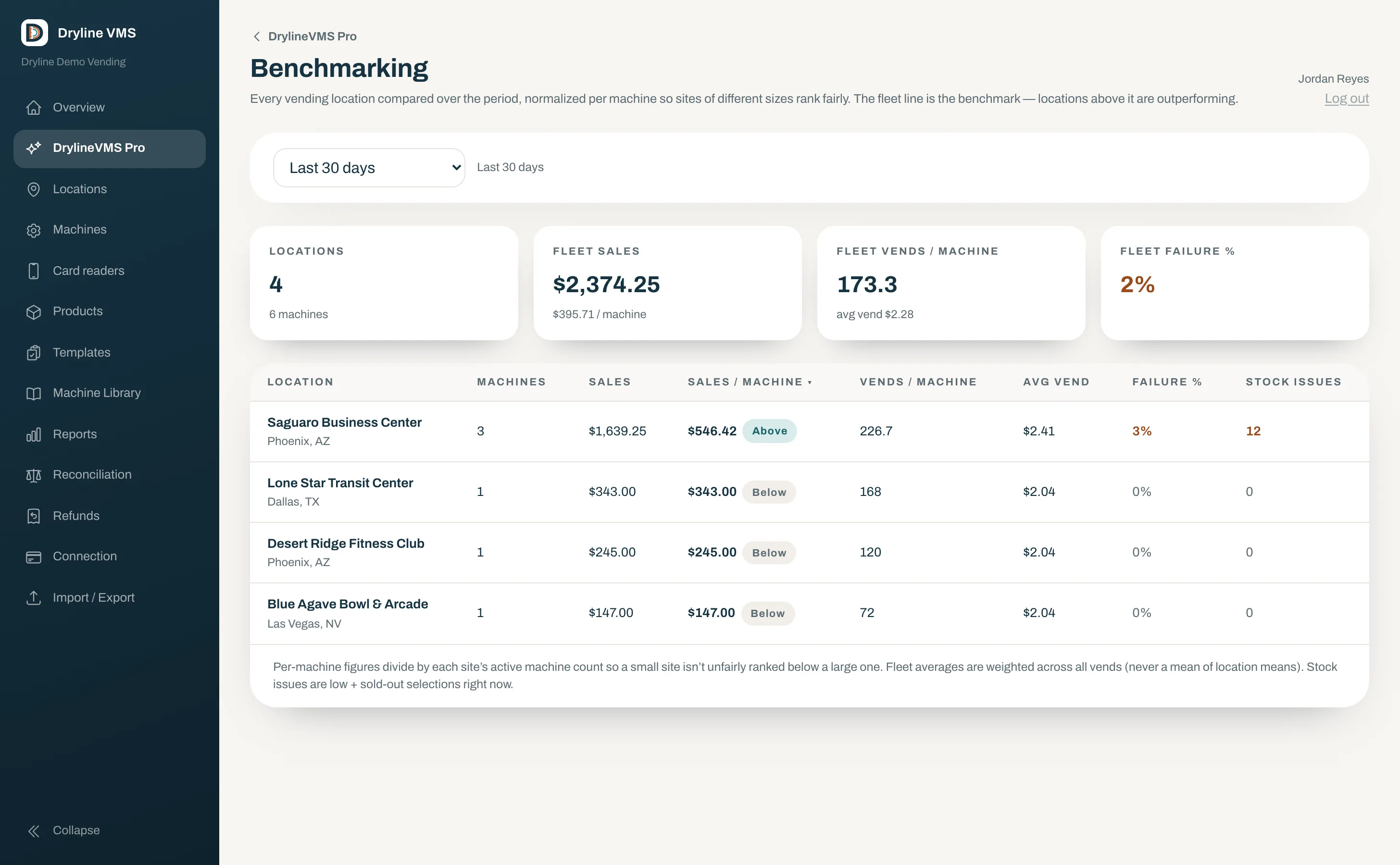
On DrylineVMS Pro, Benchmarking compares every location per machine and ranks it above or below your fleet average.
Questions about finding vending locations
- Which locations are most common for vending machines?
- Manufacturing sites, then offices, according to the NAMA Foundation’s industry census. Government buildings, colleges, hospitals and schools follow.
- How many people does a vending location need?
- A common rule of thumb is more than 50 people on site. Count them yourself: operators interviewed by Vending Times spend five or six hours counting the people who pass a spot, because moving a machine 10 to 15 feet can change the count from 200 to 10.
- What does a vending locator cost?
- Vending Times reports that locators can charge hundreds of dollars for cold calls with no guarantee, and one operator said only one or two of every ten locators delivered a satisfactory site.
More vending basics.
Why offer cashless
What card and phone payments add for customers and for you, and what a machine needs to take them.
Tap to Start, Select First, and Multivend
Pay first, choose first, or buy several items with one tap, and why your machine has a say.
How MDB works
How the controller runs the coin mechanism, bill validator, and card reader on one connection.
Planograms
The map of a machine: what goes in each slot, at what price, and how full to fill it.
Stocking strategies
A first product mix, par levels, rotation, and restocking the machines that need it.
Starting a vending business
Licenses, sales tax, insurance, machines, locations, commissions, pricing, and routes.
Agreements and commissions
What every location agreement covers, and the commission models compared with real math.
Sourcing and pricing
Where to buy as you grow, cost per unit, and pricing for margin and the location.
The Vending Operator Playbook
Every business guide in one printable workbook, with a site scorecard and a pricing worksheet (PDF).
Start your route on Dryline.
Book a 20-minute demo and set up your first machine with us on real screens.